

Is THCA Legal for Online Purchase? 2026 Guide
Table of Contents
- How Cannabis Act Regulations Shape THCA Legality
- THCA vs THC Legal Status: What the Law Actually Says
- Buying Cannabis Online Legally: Licensed Retailers Only
- How to Verify THCA Products Before You Buy
- Risks of Buying THCA Online From Unlicensed Sellers
- Your Rights and Protections When Ordering THCA Online
- Frequently Asked Questions
Last Updated: September 12, 2026
How Cannabis Act Regulations Shape THCA Legality
Whether THCA is legal for online purchase in Canada comes down to one question: does the product meet the federal definition of hemp under the Cannabis Act? Get that right and you're on solid ground. Get it wrong and you're buying a controlled substance from an unlicensed seller.
Here's the short version: Health Canada regulates cannabis under the Cannabis Act, and industrial hemp is defined separately from cannabis by its THC concentration. Products derived from hemp must stay under the regulated threshold to remain legal outside the licensed cannabis framework.
The catch is that the threshold applies to a specific measurement, not the one most sellers advertise.
Total THC vs Delta-9 THC: The Distinction That Decides Legality
The distinction that decides legality is total THC versus delta-9 THC. Raw cannabis flower contains mostly THCA, the acidic, non-psychoactive form of the molecule. Heat converts THCA into delta-9 THC through decarboxylation.
Most product labels show delta-9 THC content, which can look reassuringly low. But regulators assess total THC, which includes the THC that would form after decarboxylation. A product can pass a delta-9 reading and still fail a total THC calculation.
This is the single most misunderstood point in the entire hemp market. If a seller only shows you a delta-9 number, you don't have the information you need.
THCA vs THC Legal Status: What the Law Actually Says
THCA and THC occupy different positions under Canadian law, and the gap between them is where most confusion lives. Delta-9 THC is a controlled substance under the Cannabis Act, available only through licensed channels (laws-lois.justice.gc.ca). THCA sits in a grey zone: it isn't named as a prohibited substance on its own, but once it converts to delta-9 THC, it falls squarely under the Act.
Federal hemp rules set a maximum THC concentration for industrial hemp, measured on a dry weight basis (laws-lois.justice.gc.ca). Health Canada publishes the current thresholds and testing requirements, and they are worth reading directly rather than trusting a summary from a seller.
Decarboxylation and Why It Matters for Enforcement
Decarboxylation is the chemical reaction that turns THCA into delta-9 THC, and it happens whenever the material is heated. Smoking, vaping, baking, and even prolonged exposure to sunlight trigger it.
Enforcement follows the chemistry. A product marketed as "THCA flower" that converts to a meaningful dose of delta-9 THC when smoked is, in practice, an unlicensed cannabis product. Law enforcement and regulators assess what the product becomes, not just what it's called on the label.
Buying Cannabis Online Legally: Licensed Retailers Only
Buying cannabis online legally means buying from a licensed retailer, full stop. In provinces with a government-run online model, that means the provincial cannabis authority. In provinces with private retail, it means a provincially licensed operator. Any other seller is operating outside the legal framework, regardless of how professional the website looks.
Licensed retailers must verify age, comply with provincial shipping rules, and sell tested product. Unlicensed sellers skip all of it. The price difference you see online often reflects that gap, not a better deal.
Interstate Commerce and Shipping Restrictions
Cannabis cannot legally cross provincial borders or the national border as a consumer purchase (canada.ca). Provincial shipping restrictions mean your order is fulfilled within the province that licensed the seller. A vendor promising nationwide delivery of cannabis products is either misrepresenting the product or breaking the law.
For hemp-derived products that genuinely fall under the federal hemp framework, the rules differ from those governing cannabis. The regulatory landscape here is genuinely complicated, and it changes. Health Canada maintains current guidance on cannabis and hemp regulation, and that's the source to check before you order.
How to Verify THCA Products Before You Buy
Verification starts with the Certificate of Analysis, and it ends with you reading the actual document rather than a marketing badge. A legitimate COA comes from a third-party lab, lists the sample date, identifies the batch, and reports total THC content on a dry weight basis.
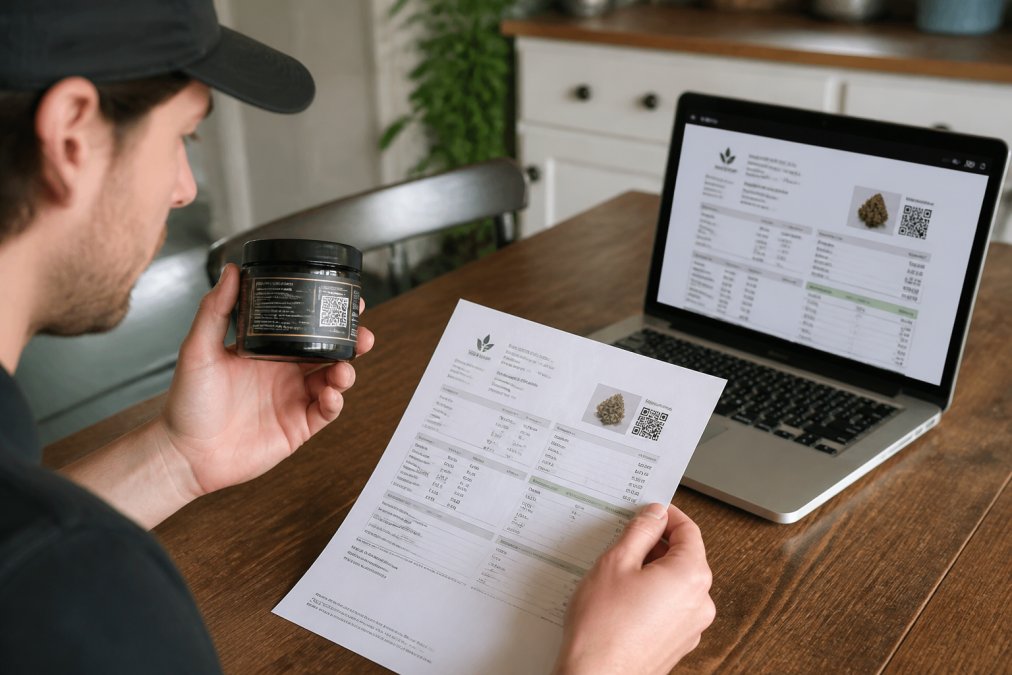
Run through this checklist before you add anything to a cart:
- Does the COA come from an accredited third-party lab?
- Is the batch or lot number on the COA the same as the one on your product?
- Does it report total THC, not just delta-9 THC?
- Is the result expressed on a dry weight basis?
- Is the sample date recent enough to reflect the current batch?
- Does the seller's licence number check out with the provincial regulator?
If a seller can't answer all six, walk away. The cost of a bad purchase is higher than the price difference.
Risks of Buying THCA Online From Unlicensed Sellers
The risks of buying from unlicensed sellers fall into three buckets: legal, financial, and health. Most guides stop at naming those buckets. The practical detail, what actually happens when something goes wrong, is where buyers get caught off guard.
Legal Risk: Possession Without Knowing It
On the legal side, you can end up in possession of a controlled substance without realizing it, because the product's actual THC content doesn't match the label. An unlicensed seller has no incentive to test accurately, and no regulator checking their numbers. If the flower in the bag tests at 18% total THC, you are holding a cannabis product under the Cannabis Act, and the label on the bag does not change that.
A common pattern is the buyer who orders what is marketed as a compliant hemp product, receives it, and only discovers the discrepancy if the package is intercepted or the product is later tested. At that point, the buyer is the one in possession.
Transit Risk: What Happens When a Package Is Intercepted
This is the risk most guides skip entirely, and it is the one buyers ask about most. When a parcel containing a controlled substance is identified in transit, the typical outcome is seizure by the carrier or by law enforcement. The package does not arrive. In some cases, the recipient address is flagged, and subsequent deliveries to that address receive additional scrutiny.
The practical consequences vary. A seized package usually means a loss notice rather than a charge, but a pattern of intercepted deliveries to the same address can escalate. The buyer's name and address are on the shipping label, which means the buyer, not the seller, is the party connected to the intercepted goods.
Cross-border shipments carry additional risk. A package crossing the national border is subject to customs inspection, and a controlled substance finding at the border is treated more seriously than a domestic carrier seizure. Vendors who ship from outside the country are exposing the buyer to that risk, not themselves.
Financial Risk: Why Chargebacks Often Fail
Financially, unlicensed sellers operate outside any consumer protection framework. If the product never arrives, or arrives as something other than what you ordered, your options are limited. Card networks and payment processors often refuse chargebacks on transactions they classify as restricted goods, which leaves you holding the loss.
The mechanism matters here. When you file a chargeback, the card issuer evaluates the transaction against the network's rules. Cannabis-related transactions frequently fall into a restricted category, and the issuer may decline the dispute on that basis alone, before even considering whether the product was misrepresented. The result is that the buyer pays, the seller keeps the money, and the dispute process closes without a refund.
A related risk is account freezing. Payment processors that discover a merchant is selling restricted goods may freeze the merchant's account and, in some cases, flag the buyer's transaction history. This is rare, but it is a real consequence that buyers rarely consider before checkout.
Health Risk: The Quiet One
Health risk is the quiet one. Untested cannabis flower can carry mould, pesticides, or heavy metals. Licensed product is tested for all of it. Unlicensed product is tested for whatever the seller felt like testing, which may be nothing.
Mould and mildew are the most common problems in untested flower, particularly in product that has been stored poorly or shipped in humid conditions. Pesticide residue is harder to detect without a lab, and heavy metals accumulate in plant tissue from contaminated soil. None of these show up in a photo or a product description.
The Practical Takeaway
The common thread across all three risk categories is that the buyer absorbs the downside. The seller collects payment up front, ships from a distance, and has no regulatory obligation to make anything right. The buyer holds the legal exposure, the financial loss, and the health risk.
Your Rights and Protections When Ordering THCA Online
Consumer rights when ordering cannabis online depend almost entirely on whether you bought from a licensed seller. Purchase from a provincially licensed retailer and you have a paper trail, a regulated return process, and a business that answers to a regulator. Purchase from an unlicensed vendor and you have whatever their terms of service say, which is usually nothing.
Chargebacks are the fallback most people assume will protect them. In practice, card issuers frequently decline disputes on cannabis-related transactions, and payment processors may freeze accounts tied to them. Treat chargeback protection as unreliable rather than guaranteed.
The practical protection is prevention. Buy from a licensed retailer, keep your COA, and pay attention to shipping restrictions in your province.
Frequently Asked Questions
Can I purchase THCA online legally?
Only from provincially or territorially licensed retailers. Under the Cannabis Act, cannabis and its derivatives must be sold through authorized channels, and each province or territory sets its own rules for online sales, age verification, and delivery. Buying from an unlicensed seller, even one claiming to sell hemp-derived THCA, falls outside the legal framework and leaves you without consumer protections.
Is THCA considered a controlled substance under the Cannabis Act?
Yes. THCA is a cannabinoid found in cannabis, and cannabis is a controlled substance under the Cannabis Act. The Act regulates tetrahydrocannabinol content on a total THC basis, which includes THCA after decarboxylation. Products marketed as hemp-derived or high-THCA do not sit outside the law simply because the label says THCA rather than THC.
What is the difference between THCA and THC in terms of legal status?
THCA is the acidic precursor that converts to THC when heated, a process called decarboxylation. Legally, the two are treated as one because regulations assess total THC content, not just delta-9 THC. That means THCA flower or extract sold online is judged by what it becomes when used, not only by what the raw lab number shows.
Are there risks associated with buying unregulated cannabis products online?
Yes. Unlicensed sellers operate outside provincial oversight, so potency claims may not match the product, lab-testing certificates can be forged, and there is no recourse if a shipment is seized in transit. Law enforcement can intercept packages, and payment disputes are harder to win when the transaction was never legal to begin with.